How to Store Necklaces, Rings, and Bracelets
CARE GUIDE
Most of the damage jewelry picks up happens while it is off the body.
A necklace spends most of its life not being worn. So does a ring, once it comes off at the sink, and a bracelet that gets pulled off with a sleeve. Tangles, scratches, and tarnish all happen in those hours, which is why how a piece is put away does more for it than how it is cleaned. Here is how we store the three categories we sell, and how we suggest you store them once they arrive.
Necklaces: Hang Them, or Lay Them in a Loose S
A chain tangles when it is dropped into a pile with its own clasp open. Close the clasp first, every time. Then either hang the necklace from a hook or a bar, or lay it flat in a loose S shape so no part of the chain crosses another. A fine chain left in a knot for a week will take a kink that never fully drops out, so a tangle is worth undoing the day you find it.
For travel, thread the chain through a drinking straw and close the clasp over the end. The straw keeps the chain straight in a bag. For a pendant necklace, let the pendant hang outside the straw and wrap the whole thing in a soft cloth.
Rings: Upright, Apart, and Never With the Keys
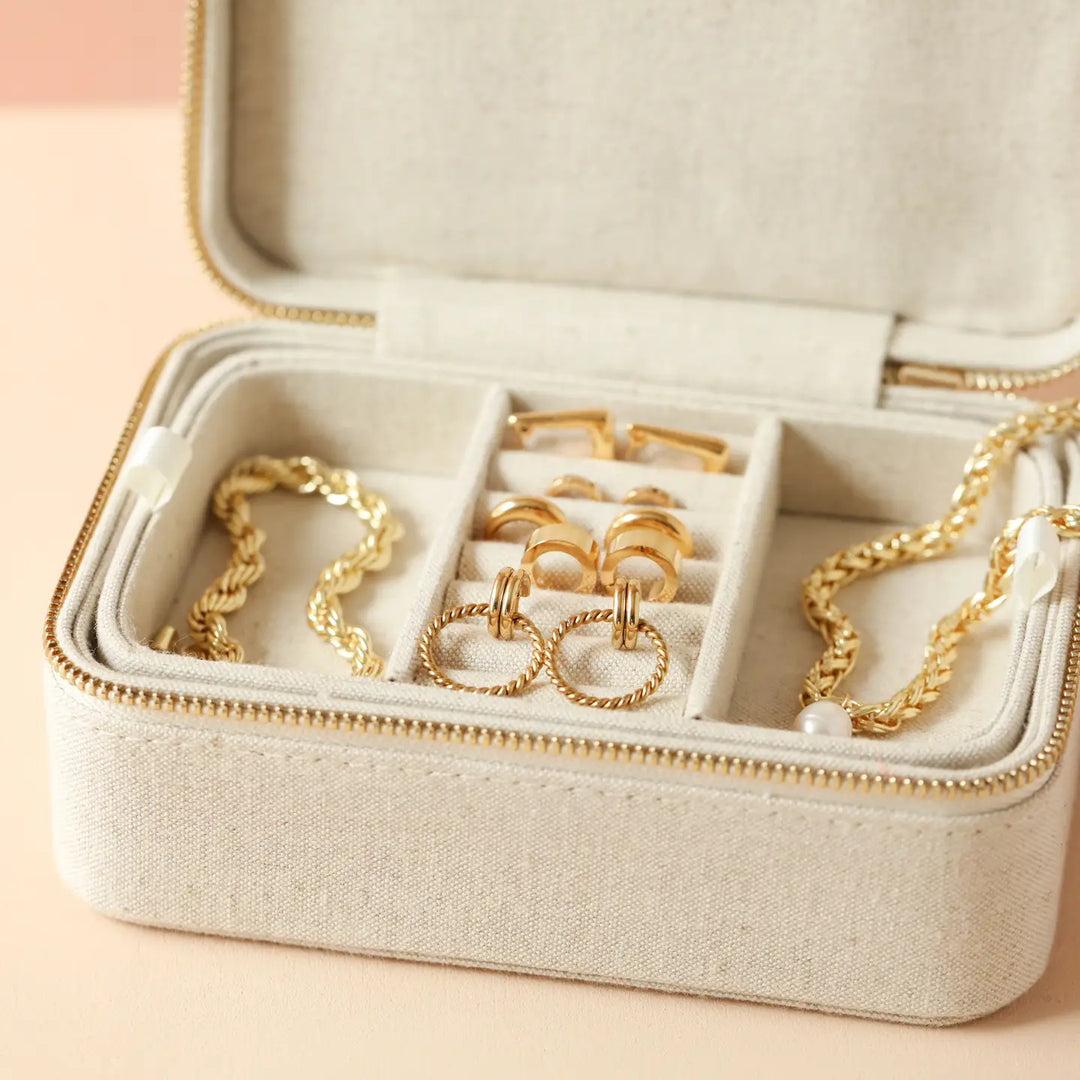
Rings scratch each other. A stone setting sitting against a plain band will leave marks on the band within a few weeks, and a dish by the door that also holds keys and coins is the fastest way to dull a polished finish. Stand rings upright in a lined slot, one to a slot, so only the lining touches the metal. A folded strip of felt in a small box does the same job as a ring roll.
If you take a ring off at the sink, give it a place of its own that is not the sink edge. A small dish away from the water is enough. Rings that go down a drain are rarely seen again.
Bracelets: Clasped Closed and Laid Flat
A chain bracelet follows the same rule as a necklace: close the clasp, then lay it flat or hang it. An open cuff should be stored at the shape it is worn at. Squeezing a cuff shut to fit a small box, or forcing it wide to slide over a hand, works the metal at the back and will eventually leave it loose. Slide a cuff on from the inside of the wrist instead, where the wrist is narrowest, and store it as it comes off.
Keep Everything Out of the Bathroom
Steam, hairspray, and perfume settle on anything left on a bathroom counter, and all three dull a finish over time. Tarnish on fashion jewelry is mostly a moisture story. Keep the box somewhere dry, and for pieces you wear less often, a small zip bag with the air pressed out slows tarnish to almost nothing. An anti-tarnish strip in the bag, swapped every few months, takes care of the rest.
A Monthly Look at the Small Parts
Once a month, open and close each clasp, run a fingertip along the extender rings, and press any stone to see whether it moves. Small parts loosen slowly, and a jump ring that has started to open can be closed with a fingernail before it lets a pendant go. If something arrived that way, or fails within the first days, our Return & Refund Policy covers it, and you can write to us from our Contact Us page with a photo.
Thank you for shopping with us, whether the piece is for you or for someone you have in mind.